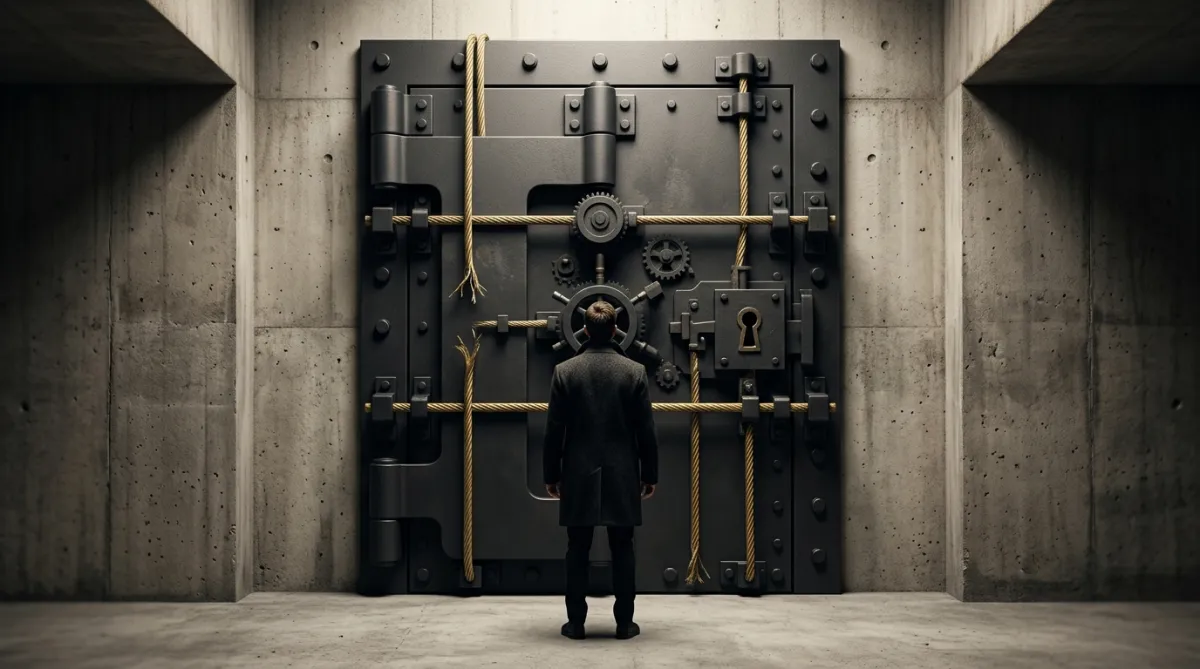
Issue 015 | Your Personality Is a Survival Strategy — And It's Quietly Running Your Life
Your personality might not be your personality. For a lot of high-achieving men, the traits you're most proud of — the vigilance, the drive, the ability to read a room in three seconds, the relentless self-sufficiency — aren't character. They're a survival strategy your nervous system built before you were old enough to choose. It kept you safe. It got you promoted. It made you money. And now, somewhere around 40, it's the exact thing making your marriage feel distant, your kids feel managed instead of known, and your inner life feel like a stranger's house.
That's the thesis of this piece: what kept you will not keep you.
What Is a Survival Personality?
A survival personality is the version of you that got constructed in childhood to navigate an emotionally unpredictable environment. Not who you are. Who you had to become to make it through.
If the adults around you were volatile, absent, critical, or emotionally checked out, your nervous system did what nervous systems do — it adapted. You learned to scan for danger. To anticipate needs. To perform. To achieve. To not need anything. To be the strong one. To disappear into competence.
Therapist and men's coach Kenny Weiss describes this pattern directly: the traits high performers are praised for — hyper-awareness, over-functioning, control — often aren't strengths at all. They're old protection mechanisms still running in the background (kennyweiss.net).
Your personality is not who you are. It's who you had to become.
The problem isn't that these traits are bad. They worked. That's the whole issue. They worked so well you built an entire adult life on top of them and never noticed the foundation was fear.
Why This Hits High Achievers Hardest
Here's the cruel part. The men who develop the strongest survival personalities often become the most externally successful. Scanning for threats makes you a great operator. Anticipating needs makes you a great salesman. Performing makes you a great leader. Not needing anything makes you a great founder.
The market rewards the exact traits that started as wounds.
So you get promoted. You build the company. You buy the house. And the whole time, the strategy is quietly compounding a second bill in the background — one that comes due in your 40s and 50s, usually inside your marriage first.
Your wife says you feel far away. Your kids are polite but don't really open up to you. You sit at dinner and can't remember the last time you felt something that wasn't productive. You've hit every external target and you still feel like you're bracing for something.
That's not a mindset problem. That's a nervous system running a program it wrote when you were seven.
The Science: Childhood Emotional Neglect and Adult Emotion Management
This isn't just clinical opinion. A peer-reviewed 2026 study published in Frontiers in Psychiatry found that childhood emotional neglect is a significant predictor of poor emotion management in adult men — and the effect holds independent of intelligence, anxiety, and depression (Frontiers in Psychiatry, Feb 2026).
Translation: the "I'm just not a feelings guy" line most men use isn't a personality trait. It's a measurable outcome of an environment where feelings wasn't safe to have.
High-performing men tend to develop what researchers call emotional compartmentalization — the ability to file feelings into boxes and only open them when it's convenient. Which is basically never. It's an elite survival skill. It's also the exact skill that makes intimacy impossible, because intimacy requires the boxes to stay open.
The market rewards the exact traits that started as wounds. That's why the bill comes so late.
How to Tell If You're Running a Survival Personality
You won't recognize it by looking for weakness. You'll recognize it by looking at your strengths and asking a harder question: when did I first need this?
A few honest signals:
- You over-function in every room you enter. If nobody's running it, you are. Not because you want to — because you can't relax if you don't.
- You read people constantly. You know the mood of a meeting before anyone speaks. You know your wife's mood from the sound of the door closing.
- You struggle to answer "what do you want?" Not about vacations. About your life. About right now.
- Rest feels dangerous. Slowing down produces anxiety, not relief.
- Your closest relationships feel more like operations than connections.
- You've achieved the thing you thought would make you feel settled, and you don't feel settled.
None of these are character flaws. They're symptoms of a system that was calibrated for a threat that isn't there anymore.
Common Mistakes Men Make When They First See It
Once a man starts to see the survival pattern, he usually does one of three things — and all three make it worse.
Mistake 1: Try to think your way out of it. You read the book. You listen to the podcast. You intellectually understand the pattern. Nothing changes. Because the pattern doesn't live in your thoughts. It lives in your body.
Mistake 2: Blow it up. Some men, when they realize how much of their life was built on the wound, want to burn it all down. Quit the company. Leave the marriage. Move to Montana. This is the survival personality wearing a new costume — the "radical honesty" version. Still running from something.
Mistake 3: Add it to the achievement list. The most common one. You turn "healing" into another performance metric. You optimize your inner work the same way you optimized revenue. You do the modality. You get the certification. You track it. You've just handed the survival personality a new job.
You cannot out-achieve a survival personality. It runs on achievement.
What Actually Works: Practical Next Steps
There's no five-step hack here. But there is a real starting point.
1. Separate the trait from the origin. Take one of your defining traits — hyper-vigilance, self-sufficiency, being the fixer — and ask when you first needed it. Not to blame anyone. To locate the age. If the trait started at eight, it's making decisions in your marriage at eight years old right now.
2. Notice the body, not the story. The survival personality shows up as a physical state before it shows up as a thought. Tight chest before the meeting. Held breath during the hard conversation with your wife. Jaw clenched when your kid asks for something. Start there. The story comes later.
3. Practice one uncomfortable honesty per day. Not a confession. A small truth you'd normally file away. "I'm tired." "I don't know." "That hurt." Say it out loud to someone who's earned it. This is how the compartments start to open without blowing up.
4. Get a real mirror. Not a hype man. Not a peer group that only celebrates wins. Someone — a therapist, a coach, a specific kind of men's work — whose job is to see the pattern you can't see and refuse to look away.
5. Stop calling it a mindset problem. It's not. Mindset work on a survival personality is like painting a house on fire. Useful eventually. Not now.
Where This Connects to the Accelerator
The What Kept You Won't Keep You Accelerator exists for the exact man this article is describing — the one who's succeeded on the outside, sensed something is off on the inside, and is done pretending the two aren't connected. If that's where you are, book a call. If it's not, this article is still yours to sit with.
The Real Shift
The goal isn't to become a different person. It's to stop being run by a strategy you didn't consciously choose.
The traits are still available to you. Vigilance, drive, competence, self-reliance — you can keep them all. But when they're chosen instead of compelled, they stop costing you the people you love. That's the whole difference.
What kept you will not keep you. Not because it was wrong. Because it was never meant to run the rest of your life.


